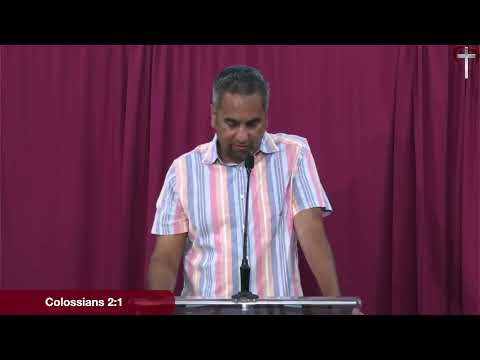
0:01 Good afternoon, church family. Good to see all of you in person. Welcome those online as well. Uh if you would turn with me to Jeremiah chapter 48, I'm going to be starting from a passage in there. Uh Jeremiah chapter 48 10 0:20 says, "Cursed, who's cursed? Cursed be the one who does the Lord's work negligently. Do you know it's possible for us to do the Lord's work and yet be cursed? Because we do it 0:40 negligently. And what does it mean to do it negligently? We talk about the three-fold work of the Lord. his work in my own life, the first floor, his work in the life of my family, the second floor, his work in the church. And in all of these areas, 0:59 we can think we're doing the Lord's work, and maybe we're doing a portion of the Lord's work, but we're a little bit negligent. And the word of the Lord is, you're cursed. You're negligent with it. And cursed be the one who restrains 1:12 his sword from blood. that we know in the Old Testament, the picture of violence. We're not called to fight against flesh and blood. The picture of the sword is a picture of our fight against principalities and powers, a fight 1:28 against the flesh. Like 2 Corinthians 10:5 says, we take every thought captive. Thoughts of self-pity, thoughts of anxiety, thoughts of suspicion, judgmental thoughts, words of gossip, words where we speak loosely, casual words, words of 1:47 the world, compromise in our own lives, in our famil family's lives, the world creeping in. Hebrews 4:12 talks about a double the word of God being a double-edged sword that separates the soloulish from the spiritual. And that's another 2:04 violent expression there, which is the fact that there are feelings that creep in that are not of the Lord. Feelings of self-pity, feelings of a victim mentality, feelings of being wronged or feelings of uh anger that I need to take 2:20 a violent sword to. And this is what it means to say at least in my own personal life, in my family's life and in the churches, in the in the building of the church that I must not restrain my sword from blood. I must not 2:36 restrain my sword. If so, I'm doing the the Lord's work negligently. And the next verse says the person who's neglecting this is the example given here is Moab. Mo Mo Mo Mo Mo Mo Mo Mo Mo Mo Mo Mo Mo Mo Mo Mo Mo Mo Mo Mo Mo Mo Mo Mo Mo Mo Mo Mo Mo Mo 2:50 Mo Mo Mo Mo Mo Mo Mo Mo Mo Mo Moab verse 11 has been at ease since his youth. He has been undisturbed like wine on its drags and he has not been emptied from vessel to vessel nor has he gone to exile. Therefore, he re retains his 3:04 flavor and his aroma has not changed. What is the aroma and what is the flavor that we're bringing? Is it unchanged from our unconverted days? Is it unchanged from our exposure to the world? from the worldliness that we see in our 3:23 classmates, in our colleagues. Is that the flavor we're bringing out? Because that's the way we were when we unconverted. We may say we're giving our lives to Jesus, but do we have this attitude of Moab which is at ease? We're 3:35 comfortable. We want a comfortable Christianity that is undisturbed. We don't want disturbances because guess what? Those disturbances, the Lord is going to use those disturbances to change our flavor. But it's too uncomfortable for us. We're 3:48 not willing to embrace that. And the test will be what is the flavor we're bringing? Is it the flavor of the Lord? In verse 12, which is a dangerous verse of uh uh prophetic verse of destruction. Therefore, behold, the days are coming, 4:00 declares the Lord, when I will send to him those who tip vessels, and they will tip Moab over, and they will empty his vessels and shatter his jars. And as I as I was meditating on these verses, I was thinking about why 4:12 is this a prophecy about Moab? What is who is Moab in this situation? So, I want to take you through a little bit of the history of Moab. And as we've heard, anything we hear in the Old Testament is a picture in the new covenant of a 4:26 battle in the spiritual realm. So, I'll share three examples from the history of Moab that show Moab at ease. So, the first one actually goes back to the uh the story of Lot. Now, why am I talking about 4:43 Lot? For those of you who don't know, Lot had the Moab started with Lot. Lot had a son whose name was Moab. And that's where the the territory of Moab comes from. And the story of Lot is you know the story of where Abraham and Lot, 5:02 you know, they didn't have enough place for their for their cattle and their livestock. And Lot chose the better, more watered area of Sodom and Gomorrah. And Adam and Abraham chose the drier space. But later on, if you if you go to 5:17 Genesis chapter 19, when the Lord himself visits with a couple of his angels to rescue Lot from Sodom and Gomorrah when it's about to be burnt up, it's interesting to see Lot's response. Genesis 19:17 5:34 says, "When God when the men of God had brought him outside once said, "Escape for your life. Do not look behind you." Genesis 19:17. And do not stay anywhere in the valley, but escape to the mountains or you will be swept 5:50 away. This is the way of the world is burning up. What should I do? I should listen to the Lord. I should listen to his command immediately. Right? What does Lot do? Lot in this moment, in this critical moment, he chooses to negotiate. He 6:09 says, Lot said to him, "Oh no, my lords." Verse 18. Verse 19. Now behold, your servant has found favor in your sight. You have magnified your loving kindness which you have shown me. But I cannot escape to the mountains for the 6:20 disaster will overtake me and I will die. Now behold, there's a town near enough for me to flee to. Let me go there. You know, if you negotiate with the Lord, you might hear a word from him which says, "Okay, my son, this is what 6:37 the verse 21 says. I grant you this request. The Lord might give you your second best request. And you may say, "Hey, I heard from the Lord. The Lord confirmed it." But that was not the will of the Lord. That was not the best that 6:50 the Lord had for Lot. The Lord God had something for Lot that required discomfort going into the mountains, but he negotiated. And the Lord said, "Okay, I'm going to let you go. You go. You go out to the valley." And that's where the 7:05 city of Moab starts with his son Moab. And you can see a picture there of him choosing a way, the easy way out rather than embracing the command of the Lord that says, "Go through this trial. Go up into the mountains. There's an enemy 7:19 there that you got to fight in the mountains." And he says, "No, I don't want any part of that. I want to I want a little bit of you. I want to obey your word. I found favor with you." Like he said, flatters the Lord with his prayers 7:29 of loving kindness and things like that. but says, "No, I don't want I heard from the Lord. He told me to go to the to the plains." The second example from Moab, if we fast forward, so Moab is the son of Lot and his descendants are called 7:47 the Moabites. If we move over to Numbers chapter 22, this is when the Israelites have left Egypt and they're wandering in the wilderness and they come to this area of Moab. And the king of Moab is a guy named Bailac. And they have a prophet of 8:06 God who's actually in touch with God over there, who's actually talking to the living God. And his name is Ba in Moab. A prophet of God living in Moab. And God is speaking to him and Bailac who is by this point an evil king is 8:23 saying hey Balam come and you you you're in touch with God. Can you go and curse these Israelites for me? Curse these people for me. And Bam said he talks to God and God says Numbers 22:12. God says no don't go with he sends a he sends a contingent. Uh the 8:40 king sends a contingent to Balam. Numbers 22:12. Um and Bam uh and and Bum checks with God and God says, "Do not go with them. You shall not curse my people for they are blessed." So they go back. The contingent goes back to the to the king. 8:58 And the king now decides to send, if you read the story, I won't go through all of the verses. He decides to to send some more distinguished people perhaps some gifts and some riches with them and a promise for a rich life. And he goes 9:11 back to Balam in verse 15 says, "Then Bailak again sent leaders more numerous and more distinguished than the former." Verse 17 and he says, "For I will indeed honor you richly the message of the king, and I will do whatever you say to 9:25 me. Please come then and curse this people for me." And Balam replied to the servants of Bailac. Sound seemingly sounding sounding like the right words. Though the king were to give me his house full of silver and gold, I could 9:38 not do anything either small or great. contrary to the command of the Lord my God. But here's where the compromise creeps in with the man of God. He says, "Okay, since you are more distinguished people," verse 19, "Since you've brought 9:51 me these gifts, please stay here tonight and I will find out what else the Lord has to say for me." A very dangerous statement. The Lord has already spoken. He's already given you the command of what you need to take the sword to. Of 10:06 what you need to give up in your life, of what relationship or relative that you need to give up in your life, what attachment to the world you need to give up in your life. Those feelings of self-pity that he wants you to to take 10:17 the sword to. And you say, "Lord, there's an attraction here. Let me check what else you have to say to me." And here we see the same danger. Verse 20, God comes to him and says, "Okay, you want 10:33 this? Uh, go with them." And we know the rest of the story. We know that the donkey speaks to Baum after that. And we the angel of the Lord tries to stop him even again in the to stop and protect the people of the Lord. But we see here 10:48 another example of a man, a man who was in touch with God, pursuing the path of ease, the path of wealth, the path of prosperity, the path of the world. And that can easily come into our lives, that can easily come into our famil family's 11:04 lives, into our children's lives, into the church when it comes to, we heard last week about being righteous with money matters, about taking debt seriously. We we've we've heard many times about how we take the lust of the eyes, how we 11:19 take bridling our tongue, the way we take thoughts captive, and we can think, you know, this is too hard. This is too uncomfortable a journey. I want a little bit of that, and I want the Lord, too. I want a little bit of 11:31 that spirit of Moab, and I don't want the spirit of the Israelites. The last example of Moab that I'll give is actually from the book of Ruth. Ruth chapter 11:52 1 verse one. Now it came about in the days when the judges governed that there was a famine in the land. And a certain man, his name was Elamec of Bethlehem and Judah went to Sirjourn. Where did he go? 12:11 Where did he wander? to the land of Moab with his wife and his two sons. I'm just going to stop there with that one verse. So, this man, he's a he's a child of God, the picture of Israel, right? He's in the new covenant church. He's in a 12:27 new covenant family. He's raising his family. And what does he do? He decides, "There's a famine here. There's a difficult situation. I can't go through this. I can't go through this difficult time that the Lord wants me to go 12:37 through. Let me go get a taste. let me go get myself fed in Moab. Let me go participate in the way of the world. Let me compromise in this area. And he goes out there and that's a good I mean he's from Bethlehem. That's the birthplace of 12:52 Jesus. And a lot of us may have started our Christian life, our Christian birth, just like this man, the Bethlehem of our journey, so to speak. And we're on our way taking up our cross every day to Calvary. But somewhere along the line, 13:05 something really uncomfortable comes and we say, "I can't take this famine. This is too difficult a trial for me. Lord, I I'm not willing to give this up. I'm not willing to give up this relationship. I'm not willing to give up this worldly 13:20 attachment that I have. I'm not willing to give up this habit that I have. And I want to I want the feast that Moab has to offer." And that's a real danger. For those of you who have not read the message that Bobby sent to 13:34 the church WhatsApp group, I encourage all of you to read it. It's a powerful message along the lines of what I'm sharing today, which is about embracing the discomfort of difficult times. Embracing the discomfort that the Lord 13:49 might have. Not just saying, not just claiming the promise that the Lord is going to deliver you. Yes, he may deliver you from that trial. There's nothing wrong with that prayer. But are you going to go into that trial with 14:00 fear and with dread? That's not the Lord's will. And uh um we see that in in this this man's wife, Elamelc. A few verses later in verse 6, it says that Naomi, who's Elamec's wife, it says in verse 14:19 six, she decided that she wants to return from the land of Moab because she heard that the Lord was visiting his people and giving him his food. And that's a sign of the repent of a repentance. And that's a picture of Naomi. She decides to go back and she 14:33 brings Ruth, her daughter-in-law, with her who's a Moabitete woman. And that's if we have gone down that path, it's not a word of condemnation here today. There is a path of repentance. There's a path of redemption. So much so that we read 14:46 that the birth line of Jesus actually comes from this Moabitete woman Ruth. So there is a path of redemption that the Lord has, but it starts with repentance. He's saying the Lord is delivering his food to his people over there. I don't 14:58 want any of this Moabitete food. Doesn't matter if there's a famine there. I want the spiritual food of God that he has for me. I'm going to return. Uh Bobby mentioned this verse in his uh uh write up today on the church 15:15 group. It said from Joshua chapter 107. He says during a difficult time, the word to Joshua was be strong and courageous. You're going, this is before the biggest battle of his life where they were going to be outnumbered. Be 15:27 careful to do according to the law all which I have commanded you. Do not turn from it to the right or to the left so that you may have success wherever you go. Isaiah 30:15 says we can mistake ease for rest. There's a lot of popular 15:46 teaching in theology that in Christian theology that the Lord has a rest for you. But they mistake rest for ease and they preach the message of the Moabites where he's like, "Oh, you can have a nice easy life. That's rest." But the 15:59 Bible says in Isaiah in Isaiah 30:15, "In repentance and rest, you will be saved." That was a message of the promised land that the Lord wanted to deliver the Israelites. There was a repentance. There was an overcoming of 16:12 giants that needed to happen before they could have that rest. It wasn't complacency and ease from the start or the ease of Moab so to speak. And later on in that chapter in verse 21, it says, "You will hear a word behind you, the 16:25 Holy Spirit of the Holy Spirit convicting you or bringing the commands of the Lord back to you, saying, you will hear a voice behind you. This is the way. Walk in it when you turn to the right or to the left." That's the same 16:35 thing the Lord told Joshua. Do not turn from it to the right or to the left. Sam Okanan, could you bring up the image that I just I just have a Google map screenshot that they'll bring up. And I was thinking about this in the context 16:52 of turning to the right or to the left. If you go down, there's a portion of Highway 101 when you go north where you keep going north. I think there's a brief period where overlaps with Highway 80 and then just kind of splits off. 17:07 That's not what's pictured here, but it splits off. 101 goes to Oregon and further up maybe to the northern California and 80 goes on to Sacramento and eastward. Now what I'm showing this picture here is sort of an 17:24 illustration a little bit further uh north northeast of uh the Bay Area you've got 80 which is sort of going northeast. Sacramento is sort of north of here, right? It's going northeast and then you've got this narrow road number 29 which goes through 17:43 Napa and then you keep following it, it actually goes up to Oregon. And I thought this was a good picture of the split between the narrow way and the broadway of destruction, the broad freeway of destruction. And counter for the new covenant 17:59 Christian, counter to what you may think. The Broadway for destruction for the new covenant Christian is not south. The broadway of destruction here is just a little bit northeast to start with and then the next day a little bit 18:18 more northeast and then a little bit more northeast and the narrow way is just getting skinnier. It's just a small two-lane uh road taking you to Oregon. That's the northbound one. And this is the way the devil and with his tactics 18:33 will deceive us. And the attitude of Moab comes in. Our danger as a new covenant Christian. It's not the slavery of Egypt, so to speak, the enslavement to the sins of this world. The danger for the new covenant Christian is the 18:47 compromise of Moab. It's the ease of Moab. It's just Yeah. It's the the right words of the Lord. It's the right prayers of the Lord. It's like Lot's prayer. I found favor on your side. Loving kindness. It's like bail. I'm talking to the Lord 19:01 every day. But each day I'm just going a little bit more northeast. That's the danger. And then where do you end up? You know where this freeway ends up? It ends up in New Jersey. New York. So you are headed to Oregon or to 19:18 Seattle. Broadway of destruction. It didn't take you to San Diego. That's actually an easier turnaround. You just turn around, get off the exit and turn around. And you find yourself getting on the wrong side of the freeway. Oh, I'm 19:28 going south. Okay, I just turn around, go north. This one's a much more dangerous one because when you look at it, I'm kind of going north. Yeah, I'm kind of going north. Just a little bit to the east, but I'm going north. And 19:39 before you know it, you're going east. The danger for the new covenant Christian is not going south, it's going east. If you turn with me to Revelation chapter 3, I talk about the message to the ch church in Leodysia, which is 20:01 similar. Revelation chapter 3, Jesus uh the word of the Lord to the to the elder in the church of Leodia says, "I know your deeds. You are neither cold nor hot. I wish that you were." Verse 15. I wish that you were cold or hot, but because you are 20:20 lukewarm and neither hot nor cold, I will spit you out of my mouth. What's worse? Being cold or lukewarm? In this case, for the new covenant Christian, the danger is lukewarmness. Just like the picture we have up, we can we can take that on. 20:36 Yeah. Um, it's not going south. That's the danger. If I'm south, the Lord can can convict me and turn. The danger is lukewarmness which is going east because you say because you're disturbing yourself saying I'm rich. I'm on my way 20:51 to heaven. I'm I'm going north sort of. I've become wealthy and have need of nothing. And you do not know that you are wretched, miserable, poor, and blind and naked. I advise you to buy from me gold refined by fire so that you may 21:05 become rich with my true riches. We talk about gold refined by fire being the trials that we go through that refine us that purify us. The difficult circumstances, not the ones, not the easy life that deceives us. And white 21:22 garments so that you may clothe yourself and that the shame of your nakedness will not be revealed. And I salve to anoint your eyes so that you may see. Therefore, those whom I love I reprove and discipline. Therefore, be zealous 21:36 and repent. Do we see the love of God, the love of the elders, children, the love of your parents when they reprove and discipline you? Do you see the love that is urging you to be zealous? Zealous for what? Not zealous for ministry. The only zeal that 21:55 matters in our Christian lives, each level, our own personal life, our family life, the church life is a zeal for repentance. And that's when the context of this verse is Jesus is standing on the knocking at the door. He's not knocking 22:10 at the door of the unbeliever. He's knocking at the door of the believer who's heading towards Moab and saying who's lukewarm saying, "Open the door. Get back on track. Get back on the narrow way." And then verse 21 says, "He who 22:27 comes, I'll grant with him to sit down with me on my throne as I sat down with my throne and my father." We've heard about this sitting on the lap of Jesus because Jesus is seated on the throne of the father. What's the prerequisite for 22:42 that? Be zealous to repent. The promise is not for the Moabitete. The promise is for the one who repents. For the one who overcomes, it says he is the one the one who's gone through the cross, who's gone through the repentance. He is the one 22:57 who will have that rest. After the repentance, in repentance and rest, you will be saved. He's the one who gets the luxury of sitting with Jesus and his father on the throne. So I want to share what must be our reaction. What must be our response 23:13 as new covenant Christians when it says that I'm cursed if my sword does not draw blood. How must I how must I respond? And here's the correct response. The opposite of the Moabitete is the Levite. I'll show you the le show you a couple of examples 23:29 from the sons of Levi and the sons of uh Judah. Starting with Exodus 32. This is a famous story in Exodus 32 where um you know Moses is up on Mount Si receiving the commandments from the Lord. And the church, the people of God below him are 23:48 compromising and they built out this golden calf. And Moses comes down and he sees the people of out of control because of their compromise. And Aaron had let them get out of control to be a derision. Imagine being a mockery to the 24:02 enemies of the people of God. Verse 25, Exodus 32:25. And it says, "Then Moses stood at the gate of the camp and he came down. He said, "Whoever is for the Lord, come to me." And he said this to all the people of Israel. All the people of 24:17 Israel, all of these ones who had just compromised and who had started worshiping this golden calf, who had fallen to the attraction of the world, so to speak. And there was only one tribe that responded. It was the tribe 24:28 of Levi, which says that all the sons of Levi, verse 26, all the sons of Levi gathered together to him. And he said to them, "Thus says the Lord, the God of Israel, every man of you, put his sword upon his thigh and go back and forth 24:42 from gate to gate in the camp and kill every man his brother and every man his friend and every man his neighbor." Now, in the spiritual realm, that's not we're not actually, like we said, we're not attacking flesh and blood, but this 24:56 is a picture of the Levites being violent with the things that were close to them that were corrupting them, that were bringing compromise into the house of God. the relationships in their lives. Talking about close relatives over here, close 25:14 friends over here that they needed to take a violent stance against the thoughts or the feelings that were taking control of them that they needed to be violent against. Again, intimate things. And then they the sons of Levi 25:31 did as Moses instructed. Verse 28. And 3,000 men. You can think of this as like 3,000 like things in my life that I've decided to cut out to really follow the way of the new covenant way of the Lord, the narrow way. And verse 29 says, Moses said, 25:49 "Dedicate yourselves today to the Lord, for every man has been against his son and against his brother in order that in order that he may bestow a blessing upon you today." And then if you go on uh to the second example which I'm going 26:06 to show you is um from Numbers 25. This is right after Balam. Um we we don't actually read this in Bible but in the story in num in numbers but it's clear from the progression that Balam actually ended up um compromising and actually c trying to 26:24 curse and trying to it says that he tried to get the Moabitete women to mix with the Israelites to bring in a spirit of compromise into the church of God. And then that's what that's a story we read about in numbers chapter 26:40 25. And then there was one man who was a Levite whose name is Phineas who said you know I can't I see compromise coming in into the church. I see compromise coming into my family. I need to do something about it. It's not affecting 26:54 me but it's affecting my family member. It's affecting the church. I need to do something about it. and he takes a sword and he comes violently against this compromise in Numbers 20 in Numbers chapter 25. Um and and this is what the 27:09 Lord says about him in Numbers 25:1. He says, "Filia Phineas, the son of Eleazar, the son of Aaron, the priest, he was the grandson of Aaron, has turned away my wrath from the sons of Israel in that he was jealous with my jealousy and 27:22 so I did not destroy the sons of Israel." And the Lord is looking for fathers and mothers like that who will be like Phineas to be violent not against maybe compromise in their own life but violent against compromise that's creeping into 27:36 their family. And he's looking for brothers and sisters who will have who will take a sword to say I want to protect the church. I want to intercede for the church and protect. And it says that before Phineas did this there was a 27:48 slow plague that was creeping into the people of Israel and it was slowly killing them. And they didn't know it, but it was just spreading and spreading and spreading. And the moment Phineas took this action, the plague stopped. 28:00 And God's blessing to him was, he said, "You, I'll make a covenant to you." Verse 13, "You and your descendants will be will have a covenant of a perpetual priesthood, a perpetual permanent priesthood in the house of the God, in 28:13 the house of the Lord because you are jealous for for the Lord and because you made atonement for the sons of Israel." And the story of the Levites, it goes on when they actually aortioning the lands to the different people. In 28:28 Deuteronomy chapter 18, it says Moses told the Levites, "You will have no inheritance. You will have no attachment to this earth or to this world. The other people want land and properties and things of this world. You will have 28:41 no attachment because the Lord will be your inheritance." And what a beautiful place to be. That's the perpetual priesthood that we're called to as new covenant Christians to say the Lord I'm content with the Lord being my only 28:53 inheritance. I don't need anything of this world. I don't need these I'm willing to take vi take captive these things that are taking me off track from the Lord. I'm willing to go up into the mountains and and not settle in the 29:08 plains, but I want the Lord to be my permanent inheritance. I'll share a couple of examples from the sons of Judah taking this battle. We we read about uh Joshua um being told by the Lord to be strong and courageous. 29:27 And then if we move on a few chapters to Joshua chapter 14, this is a story of Caleb. It's a beautiful story. This is a man who waited 45 years for this promise to be fulfilled for him and his family. 29:43 Joshua 14 verse 10, Caleb says to Joshua, "Now behold, the Lord has let me live just as he spoke these 45 years from the time that the Lord spoke this word to Moses." Joshua 14:10. When Israel walked in the 30:01 wilderness, and now, behold, I am 85 years old. I am still as strong today as I was in the day Moses sent me. My strength was then, so my strength is now for war and for going out and for coming in. Verse 12. Now then give me this hill 30:18 country about which the Lord spoke on that day. What is the day when the Lord promised this? The Lord had promised this to Caleb 45 years ago. But because of the rebellion of the people, Caleb was not allowed to go in. But he was able to intercede for his 30:35 people. Imagine this man interceding for his family. His family is who? The people of Judah. He's from the tribe of Judah. Interceding for the people of Judah and saying, "I'm going to cling on to this promise. I'm going to cling on 30:46 to this promise for 45 years. The Lord is going to deliver this." And he's not going to just deliver it through me. He's going to deliver it through me and my family. And how do I know that? The end of verse 12 says, "The Lord will be 31:00 with me and I will drive them out as the Lord has spoken." And this is the opposite. Just for a moment, I'll point out that this is the opposite of Lot. Lot was told to go up into the hill country, and he said, "No, I don't want the hill 31:11 country. I want the plains." Caleb says, "Give me the hill country. The Lord will be with me. Let me I'm going to cling on to this promise that he gave me 45 years ago, and I'm going to go to together with my family and do it." And we read 31:23 in Judges chapter 1, the story of how Caleb actually executed on that. And it wasn't by himself. Judges chapter 1:es 1-3 it says it came about after the death of Joshua the sons of J the sons of Israel inquired of the Lord who shall go up first for us 31:39 against these Canaanites in the hill country and the Lord said Judah shall go up behold I've given the land into his hand and here's a beautiful picture you can read why I know this is the story of Caleb if you read on from verse 11 to 15 31:52 it talks about Caleb actually as part of this war capturing this hill country and he did it together with his brothers. He waited 45 years to do it together with his brothers. And here's a beautiful picture I wanted to point out. Judges 32:06 1:3. It says, "Then Judah said to Simeon, come up with me into the the territory allotted with me that we may fight against the Canaanites, and I will turn and I in turn will go with you into the territory allotted with you." see a 32:24 big beautiful picture of brotherhood teaming together to fight to not just fight their own battles but to fight each other's battles. I was going through a difficult work situation a couple years ago and there was another brother in this church who 32:38 was also going through a difficult situation at that time. And I remember when I was fellowshipping with him, the Lord put it on my heart to say, "Brother, whenever I'm tempted to complain about my situation or tempted to be anxious or worry about my 32:49 situation, you know what I'm going to do? I'm going to pray for you." The moment the Lord puts that on my mind, I'm going to pray for you in your situation. That's a great way for me to intercede. This is Judah saying, "Simeon, come up with me. let me fight 33:02 your battle. Simeon saying, Judah, let me fight your battle. That's the picture of spiritual warfare that we want to have as a church where we want to be interceding for for each other, where we want to be encouraging uh each other, 33:14 where we want to building each other, fighting battles together. That's a picture that husband and wife are called to do. If your wife has a weakness, that's your weakness, too. Share in the battle with her. Like Judah shared with 33:26 Simeon, if your husband has a weakness that they're struggling with, sister, share in the battle with your husband, too. Stop pointing the finger. Stop blaming. Join in that battle together, interceding for before the Lord. I'll 33:39 share this final promise in in closing. Joshua 20, chapter 21. We started with uh the Lord saying, "Be courageous. Don't be afraid of this discomfort, uncomfortable situation that may be going through. And the end of Joshua 33:57 talks about when the war is over when Joshua 21:44 and 45 it says, "And the Lord gave them rest on every side." After this battle, the Lord gave them rest on every side according to all that he had sworn to their fathers. And no one of all the 34:14 enemies stood before them. And the Lord gave all the enemies into the hand. And I love this verse, verse 45. Not one of the good promises which the Lord had made to the house of Israel. Not one of the good promises which the Lord had 34:28 made to you, to your family, to our church failed. All of them came to pass. What a beautiful assurance that we can hold on to that the Lord will give us rest on every side if we join in this battle together. If we get back on 34:46 track, if we turn back from the path that's going towards Moab and get back on the narrow way and say, "Lord, we're willing to go up into the hill country. We're willing to fight alongside our brother. We're willing to fight 34:57 alongside our spouse." And may it be said at the end of our journey that the that not one of the good promises which the Lord had made to us, to our family, to NCCF failed all came to pass. Amen.